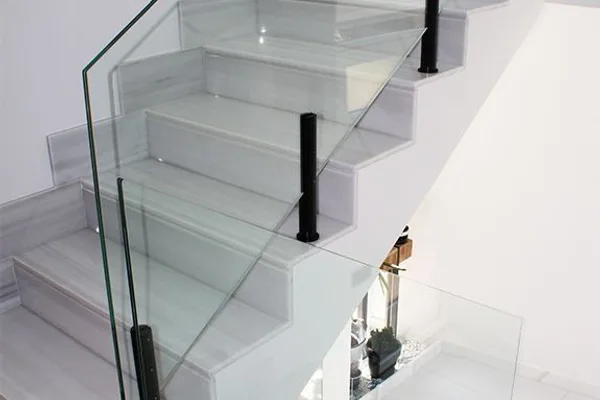
A balcony railing is a barrier before it is a design, so most of what varies between these photographs is how the glass is held and what has been done to the glass itself. Both change the price, and only one of them changes the view.
Frameless panels on spigots
Stainless-steel spigots bolted into the balcony slab grip the bottom of each panel, with nothing above them but glass. It is the most common frameless system in India because spigots are adjustable, so small errors along the slab edge can be dialled out. Every bolt hole is drilled before the glass is toughened.
Base-channel (U-profile) railings
A continuous aluminium U-channel runs along the slab edge and each panel is glazed into it with wedges and gaskets. It gives the cleanest line of any system because the fixings disappear into the channel — and it wants a straight, level, structurally sound edge to sit on, with far less adjustment available than spigots offer.
Post-and-rail and framed systems
Posts in stainless steel or aluminium carry a top rail, with glass as infill between them. Smaller panels supported on more sides mean the glass can be thinner, and the posts absorb an uneven slab edge that would defeat a frameless system. Usually the least expensive way to get glass onto a balcony.
Printed, frosted and fluted privacy panels
Where a balcony faces a neighbour rather than a view, the glass itself does the work: ceramic-printed patterns, acid-etched and sandblasted frosting, and fluted panels all obscure the view while passing daylight. All of it is done to the panel before toughening, so it is decided with the order rather than added later.
Cap rails and top edges
A slotted cap rail ties the panels together, protects the exposed top edge and gives people something to hold. Frameless balconies are often specified without one for the cleaner line, which leaves the panels and their fixings carrying everything on their own — a structural decision, not a styling one.
Weather, wind and the coast
A balcony is outdoors, and a high or coastal one is properly exposed. That pushes the hardware to a higher grade of stainless steel and makes wind pressure part of the design rather than an afterthought — IS 875 (Part 3) is the Indian code for it, and the wind load calculator gives an indicative first-cut figure.