
Glass Partitions
Glass Partition Soundproofing: How Thick Glass & Acoustic Seals Reduce Office Noise
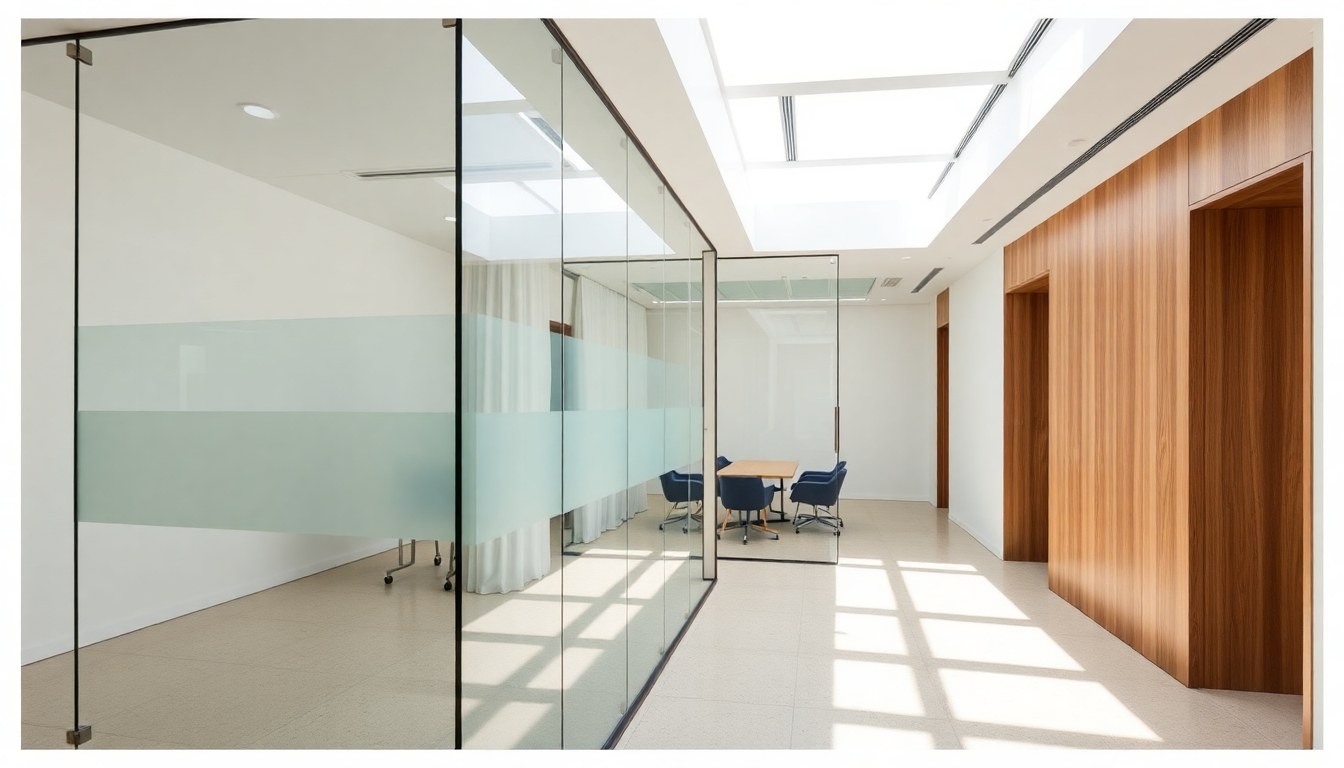
Open-plan offices have become the norm in India's growing corporate sector, but they come with a persistent problem: noise. Glass partitions offer transparency and light, yet many businesses assume they sacrifice acoustic performance. The truth is far different. Modern glass partition systems—when engineered correctly with laminated glass, insulated glass units (IGUs), and precision sealing—can reduce noise by 40–60 decibels, rivaling solid walls. This technical guide breaks down exactly how thickness, glass composition, and gap sealing work together to create genuinely quiet workspaces.
Understanding Acoustic Performance in Glass Partitions
Acoustic performance is measured in decibels (dB), a logarithmic scale where every 10dB increase represents a perceived doubling of loudness. A normal office conversation registers around 60dB, while an open-plan floor with multiple conversations, phones, and machinery can reach 70–80dB. Prolonged exposure to noise above 65dB reduces productivity, increases stress, and damages long-term hearing health.
Glass partitions reduce noise through two mechanisms: mass (thicker glass absorbs more sound energy) and damping (special interlayers convert sound vibrations into heat). A single-pane glass partition without acoustic treatment typically reduces noise by only 30–35dB—insufficient for focus-intensive work. However, laminated glass and IGU systems can achieve 45–60dB reduction, making them competitive with brick or drywall walls.
Why Standard Glass Fails
Single-pane, unlaminated glass partitions are poor acoustic barriers because sound travels through them almost unimpeded. The glass panel vibrates at the frequency of the incoming sound wave, transmitting it to the other side. This is why you can hear conversations clearly through standard office glass. Adding thickness helps (a 10mm pane is slightly better than 6mm), but the improvement is marginal without damping layers.
Laminated Glass: The Acoustic Workhorse
Laminated glass consists of two or more glass panes bonded with a polyvinyl butyral (PVB) or resin interlayer. This interlayer is the key to soundproofing. When sound vibrates the glass, the interlayer absorbs and dissipates that vibration as heat, preventing the glass from acting as a simple resonator. The thicker and more viscoelastic the interlayer, the better the acoustic performance.
Glass Thickness and Decibel Reduction
Acoustic performance improves with total glass thickness, but not linearly. Here's how typical laminated glass partitions perform in Indian office environments:
- 6mm + 0.76mm PVB + 6mm (12.76mm total): 30–35dB reduction. Suitable for low-noise areas like libraries or quiet zones.
- 8mm + 0.76mm PVB + 8mm (16.76mm total): 35–40dB reduction. Standard for general office partitioning.
- 10mm + 1.52mm PVB + 10mm (21.52mm total): 40–45dB reduction. Recommended for open-plan offices with moderate noise.
- 12mm + 1.52mm PVB + 12mm (25.52mm total): 45–50dB reduction. High-performance systems for call centers and broadcast studios.
For maximum noise control in demanding environments, some Indian corporate offices install triple-laminate systems (e.g., 10mm + 1.52mm PVB + 10mm + 1.52mm PVB + 10mm), achieving 50–55dB reduction. However, cost and weight increase significantly beyond 25mm total thickness.
Interlayer Selection Matters
Not all PVB interlayers are equal. Standard 0.76mm PVB provides basic sound dampening. Acoustic-grade interlayers (1.52mm or thicker) contain specially formulated polymers with higher damping loss factors, absorbing a broader spectrum of noise frequencies. Some manufacturers offer colored interlayers (green, bronze, grey) that also provide privacy while improving acoustics. For offices in high-noise zones (near highways, airports, or industrial areas around Bangalore, Pune, or Mumbai), acoustic-grade interlayers are worth the extra 8–12% cost.
Insulated Glass Units (IGUs) for Superior Soundproofing
An Insulated Glass Unit (IGU) consists of two or more glass panes separated by an air gap sealed with a structural sealant. While primarily designed for thermal insulation, IGUs significantly improve acoustic performance when properly configured. The air gap acts as a sound-dampening chamber, and if the two panes have different thicknesses (asymmetric design), they resonate at different frequencies, reducing the "coincidence effect" where sound passes through more easily.
Optimal IGU Configurations for Acoustics
Standard IGU partitions use equal-thickness panes (e.g., 6mm + 12mm air gap + 6mm), which provide modest acoustic benefit over single laminated glass. However, asymmetric IGUs perform significantly better:
- 8mm laminated + 12mm air gap + 10mm laminated: 45–50dB reduction. The different thicknesses prevent resonance alignment.
- 10mm laminated + 150mm air gap + 12mm laminated: 50–55dB reduction. Larger air gaps improve low-frequency noise control (HVAC, machinery).
- Sealed cavity with acoustic foam: 55–60dB reduction. Some premium systems fill the air gap with open-cell acoustic foam, absorbing sound within the cavity itself.
In India, IGU partitions are increasingly popular in Bangalore's IT parks, Mumbai's financial districts, and Hyderabad's tech campuses, where open-plan offices are standard and acoustic complaints are common. The trade-off is cost—IGU partitions run 35–50% higher than laminated-glass-only systems—and weight, requiring stronger aluminum framing.
Gap Sealing and Installation: The Often-Overlooked Factor
Even the most acoustically advanced glass loses effectiveness if gaps around the partition frame are not sealed properly. Sound travels the path of least resistance, and a 2mm gap at the base of a partition can reduce the overall acoustic performance by 10–15dB. This is why installation quality is as critical as glass specification.
Critical Sealing Points
Professional glass partition installers in India focus on these high-impact areas:
- Perimeter seals: Acoustic sealant (silicone or polyurethane with high damping properties) around the frame edges, floor, and ceiling.
- Door and window gaskets: Compression seals around operable elements. Standard rubber gaskets lose effectiveness after 2–3 years; acoustic-grade neoprene gaskets last 5+ years.
- Penetrations: Electrical outlets, HVAC ducts, and cable runs must be sealed with acoustic putty or fire-rated foam sealant.
- Structural gaps: If the partition doesn't reach the ceiling (common in rented spaces), acoustic panels or baffles must bridge the gap above the glass.
Many offices in India's commercial hubs (Gurgaon, Bangalore, Pune) overlook these details, installing premium glass but failing to seal gaps, resulting in disappointing real-world performance. A ₹5 lakh partition investment can be undermined by ₹10,000 worth of unsealed gaps.
Real-World Office Noise Testing and Performance
Laboratory acoustic ratings (Sound Reduction Index, or SRI, measured in controlled conditions) often exceed real-world performance by 3–5dB due to flanking paths (sound traveling around the partition via ducts, suspended ceilings, or structural connections). A partition rated at 50dB SRI in the lab typically achieves 45–48dB in an actual office.
Typical Indian Office Noise Scenarios
Testing by acoustic consultants in Indian corporate offices reveals real-world performance:
- Call centers with 10mm laminated glass + sealed gaps: 40–43dB reduction. Open-plan floors with multiple agents on calls generate 75–80dB ambient noise; partitions bring it down to 35–40dB in adjacent zones.
- IT offices with IGU partitions (10mm + 12mm air gap + 10mm laminated): 48–52dB reduction. Effective for reducing keyboard noise, phone notifications, and conversation from neighboring desks.
- Conference rooms with 12mm triple-laminate glass: 50–55dB reduction. Allows video calls and presentations without external noise interference.
A 2023 case study from a Bangalore IT firm measured noise reduction in their redesigned open-plan floor. After installing 10mm laminated glass partitions with acoustic sealing around 30 workstations, average noise levels dropped from 72dB to 58dB—a 14dB reduction that employees rated as "significantly improved focus and comfort."
Cost-Benefit Analysis for Indian Offices
Glass partition soundproofing requires balancing acoustic performance, budget, and space constraints. Here's what Indian businesses typically invest:
- Basic laminated glass (8mm + 0.76mm PVB + 8mm): ₹1,200–₹1,800 per square meter. Suitable for low-noise offices or as a starting point.
- Acoustic-grade laminated glass (10mm + 1.52mm PVB + 10mm): ₹2,000–₹2,800 per square meter. Best value for typical open-plan offices.
- IGU partitions (10mm laminated + 12mm air gap + 10mm laminated): ₹3,000–₹4,200 per square meter. Premium choice for high-noise environments.
- Installation and sealing (per linear meter of partition height): ₹800–₹1,500. Often underestimated but critical for performance.
Return on investment comes from improved employee productivity (studies show 5–15% productivity gains in quiet zones), reduced absenteeism due to noise-related stress, and higher employee satisfaction scores. For a 50-person open-plan office, a ₹10–₹15 lakh investment in acoustic partitions typically pays for itself within 18–24 months through productivity gains alone.
Frequently Asked Questions
How much noise does a glass partition actually reduce compared to a solid wall?
A properly designed acoustic glass partition (10mm+ laminated or IGU) reduces noise by 45–55dB, which is equivalent to or slightly better than a standard brick wall with plaster (typically 45–50dB). The advantage of glass is that it provides transparency and light while achieving comparable acoustic performance. However, solid walls filled with mineral wool insulation can exceed 60dB reduction, so glass is not superior in all cases—it's a trade-off between acoustics and visual openness.
What's the minimum glass thickness needed for acceptable soundproofing in an open-plan office?
For general office environments with moderate noise, 8–10mm laminated glass (with acoustic interlayer) is the practical minimum, providing 35–45dB reduction. Single-pane glass below 8mm is not recommended for soundproofing. If your office is in a high-noise zone (near traffic, construction, or machinery), 10mm+ laminated or IGU systems are essential. Always prioritize interlayer quality (acoustic-grade PVB) over raw thickness alone.
Do acoustic glass partitions block all frequencies equally?
No. Glass partitions are more effective at blocking high-frequency sounds (speech, phones, keyboards—2,000–8,000 Hz) than low-frequency sounds (HVAC hum, machinery, bass—100–500 Hz). This is why offices often combine glass partitions with additional low-frequency absorbers (acoustic panels, bass traps) in critical areas. Asymmetric IGU designs help by addressing different frequency ranges with different glass thicknesses.
How long do acoustic seals around glass partitions last?
Standard rubber gaskets typically remain effective for 2–3 years before losing compression and allowing sound leakage. Acoustic-grade neoprene or EPDM gaskets last 5–7 years. Silicone sealant around the perimeter can last 10+ years if applied correctly, but it should be inspected annually for cracks or separation. In Indian climates with high humidity and temperature fluctuations, seals degrade faster and require more frequent maintenance.
Can I retrofit acoustic performance to existing glass partitions?
Partially. If you have single-pane glass partitions, you can improve acoustic performance by adding acoustic panels or fabric-wrapped absorbers to adjacent surfaces, or by applying acoustic film to the glass surface (though this reduces transparency and costs ₹500–₹1,000 per square meter). However, the most effective solution is replacing the glass with laminated or IGU units. Retrofitting seals around existing partitions is cost-effective and can improve performance by 3–8dB if gaps were previously unsealed.
Partner with India's Glass Specialists
Choosing the right acoustic glass partition system requires understanding your office's noise profile, budget, and long-term needs. Whether you need basic laminated glass for a quiet workspace or premium IGU systems for a high-noise environment, finding qualified glass suppliers and installers is essential. Explore verified glass partition manufacturers and installers in your region on glassy.in, India's comprehensive glass business directory. Connect with experts who understand acoustic performance, local building codes, and can deliver installations that truly reduce noise and improve workplace comfort.