
Glass Railings
Glass Balcony Railings in High-Rise Buildings: Wind & Impact Testing
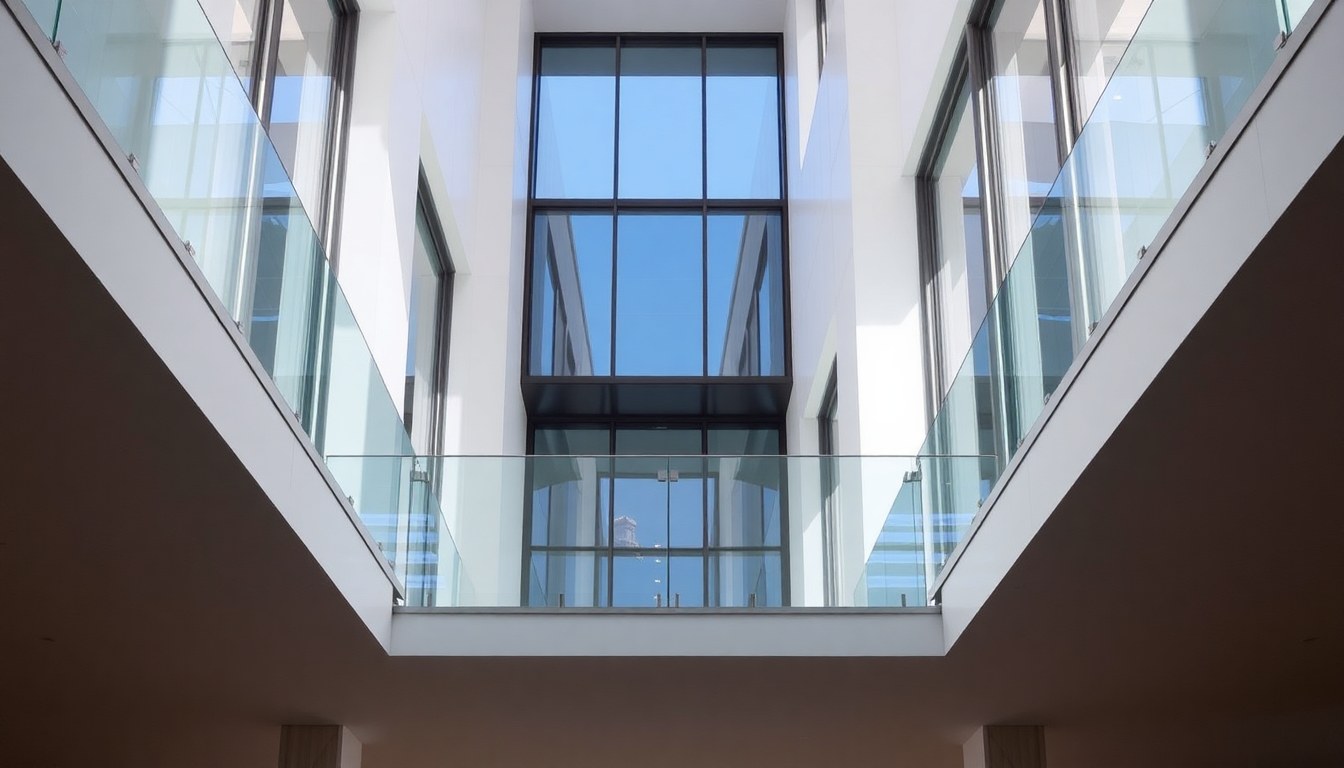
As Indian cities like Mumbai and Hyderabad push skyward with ambitious high-rise developments, glass balcony railings have become the architectural choice for modern towers—offering unobstructed views while maintaining safety. However, these frameless balustrades face extreme environmental stresses: wind pressures that increase exponentially with height, accidental impacts, and thermal cycling. Understanding the engineering behind wind load calculations, impact resistance standards, and compliance with Indian building codes is essential for architects, developers, and glass manufacturers alike.
Understanding Wind Load Pressures on High-Rise Balconies
Wind load on a balcony railing is not uniform—it increases dramatically with building height due to wind speed variation. The pressure exerted on a glass panel at the 40th floor of a Mumbai tower is substantially higher than on a ground-floor balcony. Engineers calculate design wind pressure using the formula: P = 0.5 × ρ × V² × Cf, where ρ is air density, V is wind speed, and Cf is the drag coefficient. For high-rise buildings in India, wind speeds can range from 44 m/s (157 km/h) in coastal cities to 40 m/s in inland metros during extreme weather events.
Indian Standard IS 875-3 (Code of Practice for Design Loads for Buildings and Structures: Wind Loads) mandates that balcony railings in high-rise buildings be designed for wind pressures calculated based on building height, terrain category, and local wind zone. For a 50-story tower in Mumbai, the effective wind pressure at the top can exceed 2.5 kN/m², requiring toughened glass panels of 12mm to 19mm thickness to safely distribute this load across the supporting frame.
Height-Based Wind Pressure Variation
Wind pressure increases with the square of wind speed, meaning a 10% increase in wind velocity results in a 21% increase in pressure. At heights above 30 meters, wind speed accelerates significantly due to reduced ground friction. Glass balustrades in the upper floors of Hyderabad's emerging tech parks and Mumbai's premium residential towers must be engineered to handle these exponential increases. Manufacturers and architects often conduct wind tunnel testing on scale models to validate railing performance before construction begins.
Toughened Glass: The Engineering Foundation
Toughened (tempered) glass is the material of choice for high-rise balcony railings because it is 4 to 5 times stronger than annealed glass and exhibits controlled fracture behavior. During the toughening process, glass is heated to approximately 620°C and then rapidly cooled, creating compressive stress on the surface and tensile stress in the core. This residual stress distribution allows toughened glass to absorb impact energy and wind loads without permanent deformation.
For balcony applications, Indian manufacturers typically produce toughened glass panels with thicknesses ranging from 10mm to 19mm, depending on span length and design wind pressure. A 12mm toughened glass panel with a 1.2-meter span can safely withstand wind pressures up to 2.0 kN/m², while 19mm panels are specified for longer spans (1.5m+) or higher wind zones. The glass must also meet IS 2553 (Code of Practice for Safety Requirements for Toughened Glass and Laminated Glass) to ensure quality and safety compliance.
Frameless vs. Framed Balustrades
Frameless glass balustrades, increasingly popular in high-rise residential and commercial developments, present unique engineering challenges. Without a perimeter frame, the entire wind load and impact force concentrates on the point loads where the glass panel connects to the floor and handrail. These connections—typically stainless steel spigots or patch fittings—must be engineered to transfer all loads directly into the building structure. The glass panel itself becomes a structural element, requiring higher thickness and premium quality toughening to eliminate internal stress concentrations that could lead to spontaneous fracture.
Framed balustrades distribute loads more evenly across the frame perimeter, allowing thinner glass (often 10mm) to be used. However, the frame adds visual obstruction and increases maintenance requirements due to dirt accumulation in joints. Many architects working with firms like Creative Designs Architect and Engineers choose frameless designs for premium projects, accepting the higher engineering demands in exchange for aesthetic and functional benefits.
Impact Resistance Testing and Standards
Beyond wind loads, balcony railings must withstand accidental impacts—from occupants leaning forcefully, children playing, or dropped objects. Indian Standard IS 6533 (Safety Code for Glass and Glass-Ceramic Cookware) and the more relevant IS 2553 outline impact resistance requirements for safety glass. The impact test involves dropping a 4.8 kg steel ball from a height of 1 meter onto the glass surface; the glass must not break into dangerous sharp fragments, and the impact point must show no penetration.
For high-rise balustrades, manufacturers conduct additional impact testing beyond minimum standards. A horizontal impact test, simulating a person leaning or pushing against the railing, applies a 1.0 kN load at 600mm height over a 300mm x 300mm contact area. The glass panel must not deflect more than 25mm and must show no cracking or permanent deformation. Toughened glass passes these tests reliably because the compressive surface stress prevents crack initiation at impact points.
Testing Protocols and Certification
Reputable glass manufacturers in India conduct testing through accredited laboratories such as NABL (National Accreditation Board for Testing and Calibration Laboratories) certified facilities. Test reports document glass thickness, toughening quality (measured by surface compression stress, typically 60–100 MPa for balcony applications), and impact performance. These certificates are mandatory for building approval in metropolitan areas like Mumbai and Hyderabad, where municipal corporations and state building authorities increasingly scrutinize safety documentation.
Code Compliance and Building Authority Requirements
India's National Building Code (NBC) and state-specific building bylaws mandate minimum safety standards for balcony railings. The NBC specifies that balustrades must be at least 1.1 meters high (measured from finished floor level) and must resist a horizontal load of 1.2 kN applied at the top rail. For glass balustrades, the code requires toughened or laminated glass to prevent catastrophic failure; annealed glass is prohibited for safety applications.
Mumbai's Development Control Regulations (DCR) and Hyderabad's Building Regulations further stipulate that glass railings must comply with IS 6533, IS 2553, and IS 875-3 standards. Developers must submit structural calculations, wind load analysis, and material test certificates as part of the building approval process. Non-compliance can result in project delays, forced modifications, or even demolition orders in extreme cases. Architects and structural engineers must work closely with glass suppliers to ensure all components meet documented standards.
Documentation and Approvals
Obtaining building approval for glass balustrades requires a comprehensive technical package: structural design drawings, wind load calculations (often conducted by external wind engineering consultants), material test certificates from the glass manufacturer, and installation details showing how the glass connects to the building structure. For complex high-rise projects, third-party inspections during installation are common, with engineers verifying that glass thickness, toughening quality, and connection details match the approved design.
Frameless Design Challenges and Solutions
Frameless balustrades introduce several engineering challenges absent in framed systems. The primary concern is load concentration at spigot connections. A single 10mm x 10mm stainless steel spigot must transfer the entire wind load from a 1.2m-wide, 1.1m-tall glass panel—potentially exceeding 3 kN of force—into the building structure. If the connection is undersized or installed incorrectly, the glass can shatter due to localized stress concentration.
To mitigate this risk, engineers specify larger diameter spigots (typically 16mm to 20mm), use multiple connection points per panel, or employ hybrid designs with minimal top and bottom frames. The glass thickness must also be increased; frameless applications typically require 15mm to 19mm toughened glass even for moderate wind zones. Additionally, the connection detail must accommodate thermal expansion—glass expands and contracts with temperature changes, and rigid connections can create internal stress that leads to delayed fracture.
Thermal Stress and Long-Term Durability
High-rise balconies experience significant temperature swings. In Mumbai, a south-facing balcony can reach 60°C in direct sunlight and cool to 25°C at night—a 35°C differential. This thermal cycling induces stress in the glass and at connection points. Frameless systems must use elastomeric gaskets or flexible fastening systems that allow 2–3mm of movement without compromising the weathertight seal. Poor thermal design has caused premature failures in older high-rise projects, where glass panels cracked months or years after installation due to accumulated thermal stress.
Material Selection and Quality Assurance
Not all toughened glass is equal. The quality of toughening—measured by surface compression stress and edge strength—varies significantly between manufacturers. Premium-grade toughened glass for high-rise applications should have surface compression stress in the range of 80–100 MPa (verified by polariscope testing) and edge strength exceeding 120 MPa. Inferior toughening can result in spontaneous breakage due to nickel sulfide (NiS) inclusions, a rare but documented failure mode in low-quality glass.
Leading Indian glass manufacturers, including those listed on glassy.in's directory, source raw glass from certified suppliers, maintain strict toughening process controls, and conduct batch testing to ensure consistency. When specifying glass for high-rise balustrades, architects should request material certifications, toughening quality reports, and references from similar completed projects. Cheaper glass may be tempting but poses unacceptable safety risks in high-rise environments where failure consequences are severe.
Real-World Application: Mumbai and Hyderabad High-Rise Projects
Mumbai's premium residential towers, such as those in Bandra and Worli, have extensively adopted frameless glass balustrades following successful wind tunnel testing and regulatory approvals. Hyderabad's rapidly developing IT corridor and residential areas around Madhapur and Jubilee Hills have similarly embraced glass railing technology, with architects like those at Infinity Design Studio incorporating advanced glass systems into modern designs. These projects demonstrate that with proper engineering, testing, and compliance, glass balustrades can safely serve buildings exceeding 60 stories.
A notable example is the adoption of 19mm toughened glass panels with stainless steel spigot connections in Mumbai's 50+ story towers, where wind speeds can approach 50 m/s during monsoon events. These installations have performed reliably for over a decade, validating the engineering approaches outlined in this article. However, each project remains unique—site-specific wind studies, building geometry, and structural considerations require custom engineering rather than one-size-fits-all solutions.
Frequently Asked Questions
What is the minimum glass thickness required for a 40-story high-rise balcony railing?
The minimum thickness depends on wind zone classification, balcony orientation, and railing design (framed vs. frameless). For a 40-story building in Mumbai (wind zone 3, design wind speed ~44 m/s), frameless balustrades typically require 15mm to 19mm toughened glass, while framed systems may use 10mm to 12mm glass. Structural calculations based on IS 875-3 must determine the exact thickness for your specific project.
How often should glass balcony railings be inspected?
Annual visual inspections are recommended to check for cracks, connection degradation, and seal deterioration. After extreme weather events (heavy storms, earthquakes), immediate inspections are essential. Professional inspections by structural engineers should be conducted every 5 years, particularly in coastal areas where salt spray accelerates corrosion of stainless steel connections.
Can laminated glass be used instead of toughened glass for balcony railings?
Yes, laminated glass (two or more panes bonded with PVB interlayer) meets IS 2553 safety requirements and can be used for balustrades. Laminated glass does not shatter into sharp fragments; instead, it remains bonded to the interlayer. However, laminated glass is heavier, more expensive, and less transparent than toughened glass. It is typically reserved for applications requiring enhanced impact resistance or sound insulation.
What happens if wind load calculations are not performed for a glass balcony installation?
Skipping wind load analysis is a serious compliance violation. Building authorities can reject the project, impose fines, or mandate costly retrofits. More critically, inadequately designed glass railings can fail catastrophically during storms, creating life-safety hazards. Wind load calculations are non-negotiable for high-rise applications and are required by Indian building codes and insurance underwriters.
Are frameless balustrades more expensive than framed designs?
Yes, frameless systems typically cost 20–40% more than framed alternatives due to thicker glass, precision engineering, and specialized installation requirements. However, the aesthetic premium and unobstructed views justify the cost for high-end residential and commercial projects. Framed systems offer better value for budget-conscious developments where views are secondary to cost control.
Conclusion: Engineering Safety Into Modern High-Rise Design
Glass balcony railings have become indispensable in contemporary high-rise architecture, delivering aesthetic elegance without sacrificing safety—provided they are engineered rigorously. Wind load calculations, impact resistance testing, material quality assurance, and strict code compliance form the foundation of reliable balustrade systems. Whether you are an architect designing a premium tower in Mumbai, a developer in Hyderabad, or a glass manufacturer supplying components, understanding these engineering principles is essential.
The Indian glass industry has matured significantly, with manufacturers now capable of producing world-class toughened glass and balustrade systems. By partnering with certified suppliers, conducting third-party testing, and adhering to IS standards, developers can confidently specify glass railings that will perform safely for decades. Explore India's leading glass businesses and architects on glassy.in to find specialists experienced in high-rise glass balustrade design and installation for your next project.